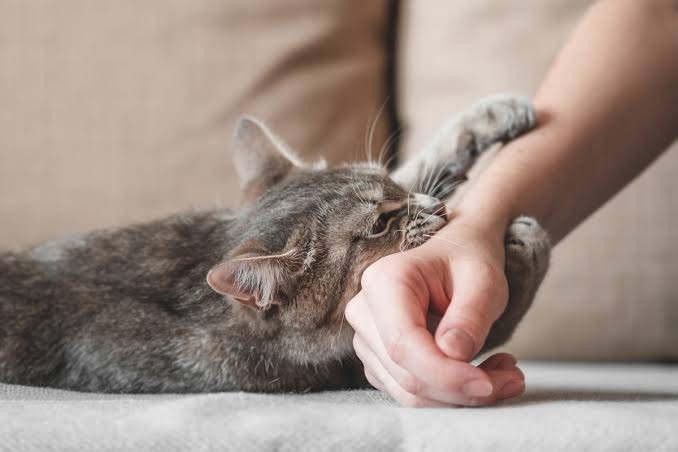

One second your cat is purring on your lap, eyes half-closed, the picture of contentment.
The next second — teeth.
It happens so fast you don’t even register it immediately. Then you look down at your hand and wonder what exactly just occurred, and whether your cat has completely lost their mind.
They haven’t. There’s a very specific reason behind every cat bite — and once you understand those reasons, the behavior stops feeling random and starts making complete sense.
Here’s everything you need to know.
First — Not All Cat Bites Are the Same
This is the most important thing to understand before anything else.
There’s a massive difference between a cat that gently nibbles your finger while you’re cuddling and a cat that clamps down hard mid-petting session. Same action on the surface. Completely different meaning underneath.
Figuring out which kind of bite your cat is giving you is the first step to figuring out why.
The Love Bite — Yes, It’s a Real Thing
You’re sitting together. Your cat is grooming your hand — licking it in slow, methodical strokes. Then they pause, open their mouth slightly, and give your finger a small, gentle nip. No pressure. No broken skin. Then back to licking.
That’s a love bite. And it’s exactly what it sounds like.
This behavior comes directly from kittenhood. Mother cats groom their kittens with a combination of licking and light nipping. Kittens do the same to each other as they grow. It’s social bonding through grooming — a physical language that says you are mine and I care about you.
When your adult cat does this to you, they’ve slotted you into the same category as their closest companions. You are being groomed. You are being claimed. The nibble isn’t aggression — it’s affection expressed in the only physical vocabulary they grew up with.
The key identifiers: the bite is light, doesn’t hurt, often happens after or during licking, and your cat’s body is relaxed throughout. They’re not tense. They’re not watching you with wide eyes. They’re just… close, and comfortable, and briefly using their teeth to say so.
The Overstimulation Bite — The Most Misunderstood One
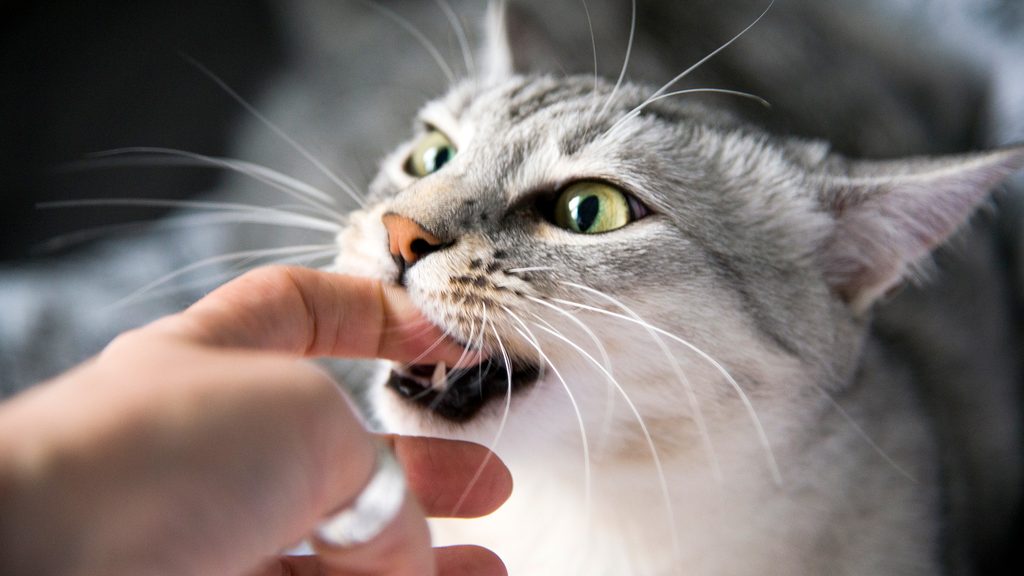
This is the one that genuinely confuses people, because the setup feels so wrong.
Your cat climbed onto your lap voluntarily. They settled in. They were purring. You were petting them and everything was fine — and then out of nowhere, they bit you.
This is called petting-induced aggression, and science has a clear explanation for it.
Cats have an extremely high density of sensory receptors in their skin. What starts as pleasant stimulation can, with repetition, tip over into something that feels irritating or overwhelming — similar to how a repeated light touch on human skin eventually starts to feel unpleasant even if it was fine at first.
Every cat has a threshold — a point where enough is enough. Some cats can be petted for twenty minutes without issue. Others hit their limit in under a minute. The threshold varies wildly by individual, by mood, by where you’re touching, and by how much stimulation they’ve already had that day.
When they cross that threshold, the bite is their most direct communication: this needs to stop right now.
The frustrating part is that cats almost always give warning signs before this bite — but humans consistently miss them. Watch for:
- A tail that starts flicking or thumping
- Skin rippling across their back
- Ears swiveling backward or flattening
- Their body going slightly rigid
- Them turning their head to look at your hand
Any one of these signals means you have about three seconds before a bite. Remove your hand calmly the moment you notice them. No drama, no scolding — just stop. Most cats will relax again almost immediately once the stimulation stops.
The Play Bite — Your Hand Is Being Hunted
You’re moving your fingers across the floor. Your cat’s eyes lock onto them. The pupils expand. The hindquarters start to wiggle. And then they launch.
This isn’t aggression. This is predator behavior, and it’s completely natural.
Cats are hardwired hunters. Their brains are built to track movement, calculate distance, and strike. When your hand moves in a way that resembles prey — darting across a surface, moving under a blanket, dangling from above — their instincts activate before their brain catches up with the fact that it’s you.
Play biting is especially common in younger cats and kittens, who are still developing their hunting skills and have enormous energy reserves to burn through. But cats of all ages can play-bite if they’re understimulated or just in the mood for a hunt.
The solution is simple in principle: never use your hands as toys. Always use a wand, a feather, a ball — something with distance between your skin and their teeth. Your hands should be associated with petting and feeding, not with prey. When those lines get blurry through play, biting during calm moments becomes more likely too.
The Fear Bite — Back Off
If you reach for a cat who doesn’t want to be touched — a stranger’s cat, a cat in a new environment, your own cat when they’re startled or already stressed — and they bite, that’s a fear bite.
It’s self-defense. The cat felt threatened and used the fastest tool available to them.
Fear bites tend to be sharper and more decisive than other types. The body language beforehand tells the story: flat ears, wide eyes, tucked or puffed tail, possibly hissing or growling. These are not subtle signals. The cat is saying very clearly that they want space.
The lesson here is to always let a cat choose contact on their own terms — especially in unfamiliar situations. A cat that feels it has the option to leave will rarely bite. A cat that feels cornered will.
The Pain Bite — Something Is Wrong
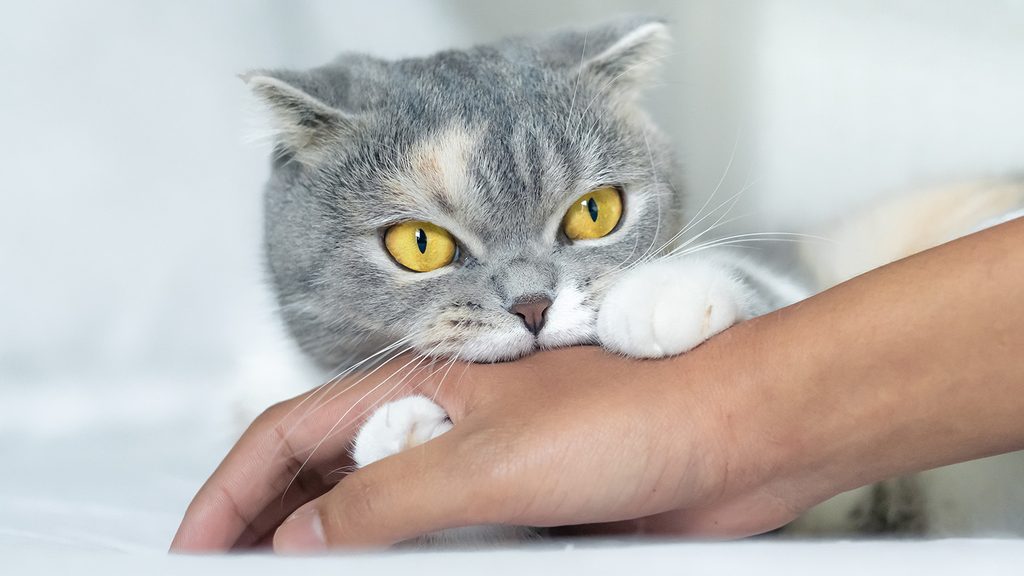
This one matters and it’s easy to miss.
If your cat has never bitten you before and suddenly starts biting when you touch certain areas — or bites unpredictably when previously they were calm — pain is a real possibility.
Cats hide pain instinctively. They don’t limp over and show you what’s wrong. Instead, when touch reaches a painful area, they bite. It’s a reflex, the same way a person might swat away a hand that pressed on a bruise.
Common culprits include arthritis (especially along the spine and tail base, which many people pet without thinking), dental disease, skin conditions, or internal issues that make general handling uncomfortable.
If the biting is new, sudden, or inconsistent with your cat’s usual personality — especially in an older cat — a vet visit is worth having. It’s not a behavior problem. It may be a health problem wearing a behavior problem’s clothes.
What to Do When Your Cat Bites
A few things that help — and one thing that makes everything worse:
Stop immediately. The moment a bite happens, freeze, then calmly withdraw your hand. No yelping, no jerking away dramatically — fast movement during a bite makes cats bite down harder by reflex.
Don’t punish them. No scolding, no pushing, no spray bottles. Punishment doesn’t teach cats what you want them to do instead — it teaches them that your hands are unpredictable and potentially threatening. This makes future biting more likely, not less.
Learn their limit. If overstimulation biting is the issue, start paying attention to how long your cat tolerates petting before they tense up. Stop a full minute before that point. End sessions on positive terms. Over time, many cats actually extend their threshold when they learn that touch reliably stops before it becomes uncomfortable.
Redirect play energy. If play biting is the issue, invest in proper toys and use them consistently. A wand toy for fifteen minutes before a cuddle session often prevents the hunting energy from spilling over onto your hands.
See a vet if the behavior is new. Sudden biting in a previously gentle cat is always worth investigating medically before assuming it’s behavioral.
The Quick Reference
| Type of Bite | What It Looks Like | What It Means |
|---|---|---|
| Love bite | Gentle nibble during grooming, no pain | Affection — they’re bonding with you |
| Overstimulation bite | Firm bite mid-petting session | Too much — they hit their limit |
| Play bite | Pouncing on moving hands | Prey drive activated |
| Fear bite | Bite when cornered or startled | Self-defense |
| Pain bite | Sudden biting at a specific spot | Possible medical issue |
FAQs
Why does my cat bite me and then lick me?
That’s a love bite. The licking and nibbling together are grooming behavior — your cat is treating you the way cats treat their closest companions. It’s a compliment, even if it doesn’t always feel like one.
Why does my cat bite me when I stop petting them?
This is the opposite of overstimulation — your cat wanted more contact, not less. Some cats become mildly frustrated when petting stops and use a nip to signal “continue.” Try tapering off gradually rather than stopping abruptly.
My cat bites me for no reason. What’s happening?
There’s always a reason — it’s just not always visible. Check for the warning signs that precede overstimulation bites. Consider whether your cat has enough play and exercise. And if the biting is genuinely sudden and new, have them checked by a vet for pain.
Should I be worried about cat bites getting infected?
Cat bites can introduce bacteria deep into tissue even when the wound looks small. Any bite that breaks the skin should be cleaned thoroughly with soap and water. If there’s redness, swelling, or warmth spreading from the bite in the following hours, see a doctor. Cat bites have a higher infection risk than they appear to.
My kitten bites constantly. Is this normal?
Yes — kittens bite as part of play and because they’re teething. The key is to redirect immediately onto toys rather than hands, so they learn from the start that skin is not an appropriate target. Most kittens naturally reduce biting as they mature if redirected consistently.
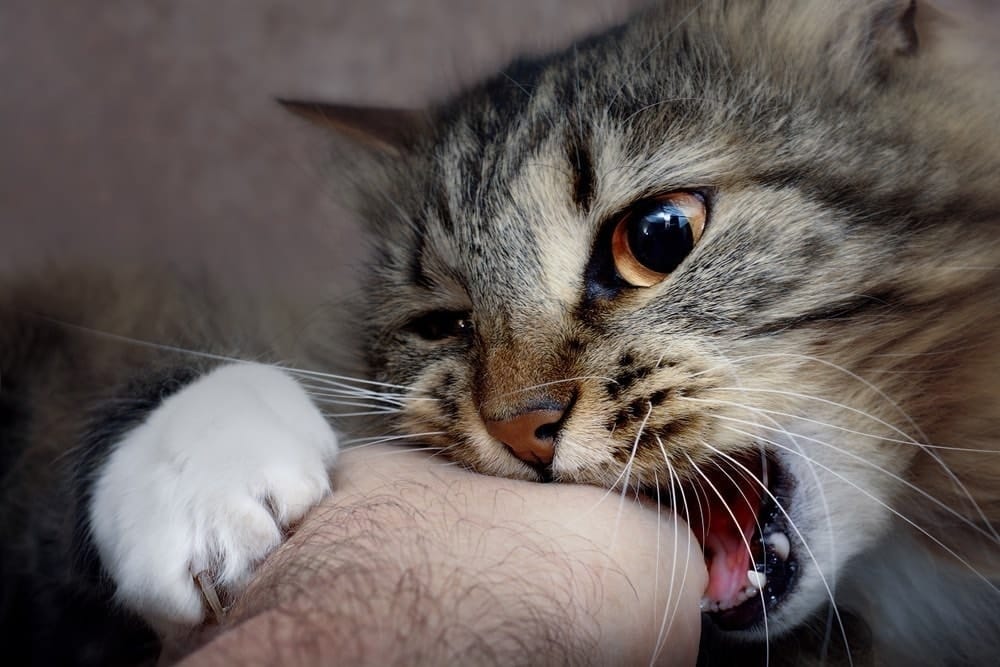
Final Thoughts
Your cat biting you is never random — even when it feels that way.
It’s love, or overstimulation, or play, or fear, or pain. Every bite has a cause. And every cause has a response that actually works.
Learn the difference between the types. Watch the warning signs before overstimulation bites. Keep your hands out of play sessions. Let your cat come to you on their terms.
Do that, and the biting drops off dramatically — leaving you with a cat who shows affection in all the other ways they know how.
The ones that don’t involve teeth. 🐱