
You set an alarm every morning to feed your cat. You rush home during lunch breaks because you’re worried they’ve been hungry for hours. You lie awake on vacation wondering if they’ve missed a meal.
Sound exhausting? It is.
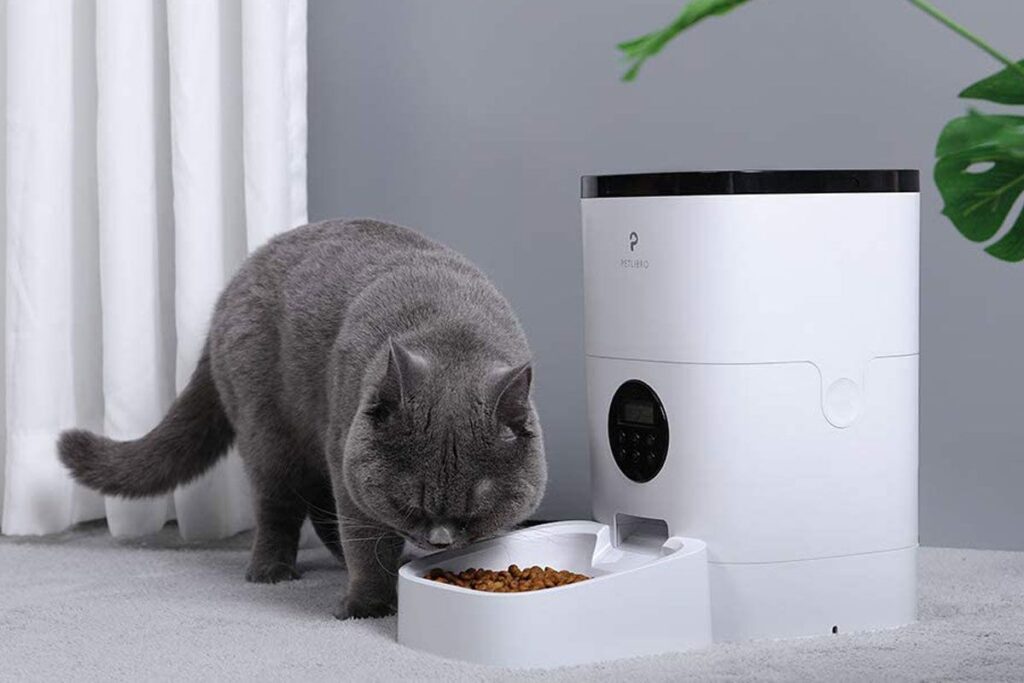
An automatic cat feeder fixes all of that.
It dispenses the right amount of food at exactly the right time — whether you’re stuck in a meeting, sound asleep, or three states away. Your cat eats on schedule. You stop worrying. Everyone wins.
But with dozens of options flooding the market, choosing the wrong one means a cat that either overeats, goes hungry when it jams, or simply refuses to use it.
This guide breaks down everything you need to know — types, features, top models, costs, and exactly how to choose the right one for your specific cat.
Table of Contents
- What Is an Automatic Cat Feeder and Why Do You Need One?
- 6 Real Benefits of an Automatic Cat Feeder
- Types of Automatic Cat Feeders
- Must-Have Features Before You Buy
- Best Automatic Cat Feeders in 2025
- Automatic Cat Feeder for Wet Food vs. Dry Food
- How to Set Up an Automatic Cat Feeder
- Automatic Cat Feeders for Multiple Cats
- Common Problems and How to Solve Them
- How Much Does an Automatic Cat Feeder Cost?
- FAQs About Automatic Cat Feeders
What Is an Automatic Cat Feeder and Why Do You Need One?
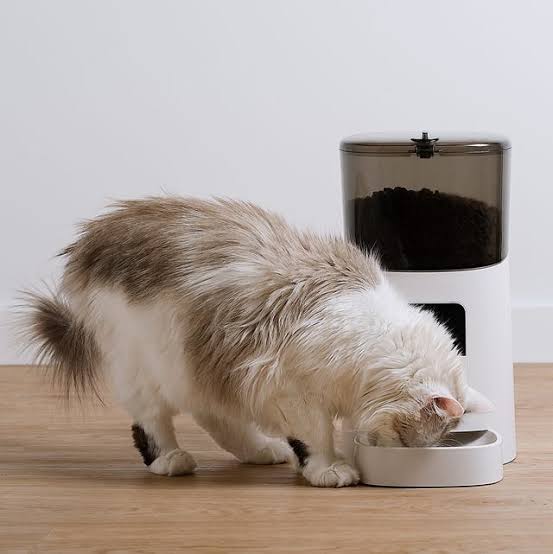
An automatic cat feeder is a programmable device that dispenses pre-set portions of food at scheduled times throughout the day — without you being physically present.
You set the schedule once. The feeder handles the rest.
It’s not just a convenience gadget. For many cats, it’s a health tool. Cats that free-feed from an always-full bowl eat constantly — which leads to obesity, diabetes, and joint problems. An automatic feeder controls exactly how much food your cat gets and when they get it.
You need an automatic cat feeder if:
- You work long hours and can’t always be home at feeding time
- Your cat wakes you up at 4 or 5 AM demanding breakfast
- Your cat overeats and is overweight
- You travel and rely on pet sitters who sometimes forget
- You have a cat on a prescription diet with strict portion control
- You have multiple cats that steal each other’s food
6 Real Benefits of an Automatic Cat Feeder
🐱 1. Perfect Portion Control Every Single Time
Overfeeding is the leading cause of feline obesity. An automatic feeder dispenses an exact, pre-measured amount at every meal — not a rough scoop, not an estimate. The same amount, every time, every day.
🐱 2. Consistent Feeding Schedule
Cats thrive on routine. Their digestive system, metabolism, and stress levels all benefit from eating at the same time every day. An automatic feeder delivers that consistency whether you’re home or not.
🐱 3. Stops the 4 AM Breakfast Alarm
Every cat owner knows the feeling — a paw on the face, loud meowing, or something being pushed off the nightstand at dawn. Set your automatic feeder to dispense a small portion at 6 AM and your cat will redirect all that early morning energy to the feeder instead of your face.
🐱 4. Gives You Freedom Without Guilt
Work late. Take a weekend trip. Stay out for dinner. Your cat is fed, on schedule, with zero dependence on you being home at a specific time.
🐱 5. Helps Manage Medical Diets
Cats with diabetes, kidney disease, or weight issues often need precise meal timing and portion sizes as part of their treatment. An automatic feeder manages this perfectly — no guesswork, no missed doses.
🐱 6. Reduces Food-Related Stress Behavior
Cats that aren’t sure when their next meal is coming develop anxiety — begging, pacing, or aggressive food behavior. A predictable schedule eliminates that uncertainty and visibly calms food-anxious cats within days.
Types of Automatic Cat Feeders
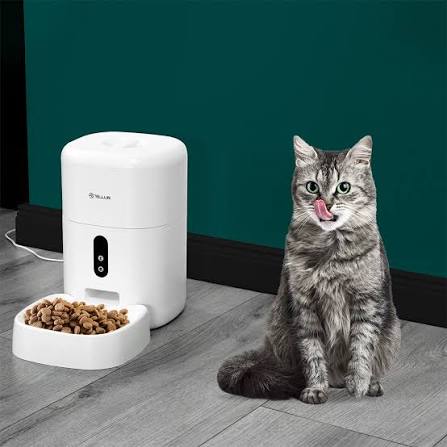
Not all automatic feeders work the same way. Here are the four main types:
🔄 1. Gravity Feeders (Simplest — Least Control)
Food flows down from a reservoir into the bowl automatically as the cat eats. No programming, no schedule, no electronics.
Pros: Cheap, reliable, no power needed, never runs out mid-day. Cons: Zero portion control — your cat eats as much as they want, whenever they want. Terrible for overweight cats. Not a true “automatic” feeder in the scheduling sense.
Best for: Healthy cats at ideal weight who simply need a constant food source.
⏰ 2. Programmable Timed Feeders (Most Common)
A motorized hopper or rotating tray dispenses specific portions at specific times you program in. Most basic models allow 1–6 meals per day.
Pros: Genuine portion control, scheduled meals, affordable, no Wi-Fi required. Cons: No remote control or monitoring. If it jams, you won’t know unless you’re home.
Best for: Cat owners who want scheduled feeding without needing smartphone control.
📱 3. Wi-Fi Smart Feeders (Best Overall)
Connects to your home Wi-Fi and is controlled through a smartphone app. Set schedules, adjust portions, dispense extra meals remotely, receive low-food alerts, and monitor feeding logs — all from your phone anywhere in the world.
Pros: Complete remote control, feeding history, push notifications, manual feed button in app. Cons: Depends on Wi-Fi connection. Usually more expensive.
Best for: Busy professionals, frequent travelers, and anyone who wants full visibility and control.
📷 4. Smart Feeders with Built-In Camera
Everything a Wi-Fi feeder does — plus a 1080p or 2K camera with night vision and two-way audio. Watch your cat eat in real-time. Talk to them from your office. Get AI-powered alerts when your cat approaches the feeder.
Pros: Live video, two-way communication, peace of mind while away. Cons: Most expensive category. Camera requires stable Wi-Fi.
Best for: Cat parents who travel frequently and want to feel connected to their pet while away.
Must-Have Features Before You Buy
This is the section that saves you from buying the wrong feeder. Check every single one of these:
✅ 1. Dual Power — Plug-In AND Battery Backup
This is non-negotiable. Power outages happen. Wi-Fi drops. If your feeder runs only on plug power and the electricity goes out — your cat misses every meal until you get home.
Look for a feeder that runs on AC power with AA or D-cell battery backup. The battery kicks in automatically during outages. Your cat never notices a thing.
✅ 2. Anti-Clog Mechanism
Kibble jams are the most common complaint about automatic feeders. Food pieces lodge in the dispensing chute and meals stop entirely.
Quality feeders use silicone rotors, wide dispensing chutes, and motors that reverse direction automatically when a jam is detected. If a feeder has hundreds of reviews complaining about jamming — skip it.
✅ 3. Stainless Steel or Ceramic Bowl
Plastic bowls develop microscopic scratches over time. Bacteria builds up in those scratches and causes feline acne — chin infections that appear as black spots or bumps on your cat’s face.
Always choose a feeder with a removable stainless steel or ceramic bowl. They’re easier to clean, safer for your cat, and last much longer.
✅ 4. Airtight Food Storage
The hopper stores dry food for days at a time. Without a proper seal, moisture seeps in and the kibble goes stale, soft, or moldy — and cats will refuse stale food.
Look for: Twist-lock lids, silicone gaskets, and built-in desiccant baskets that absorb moisture actively.
✅ 5. Accurate Portion Control
Cheap feeders measure in scoops — which is wildly inaccurate depending on kibble size. Premium feeders measure in grams. If your cat is on a specific calorie target, gram-accurate dispensing matters significantly.
✅ 6. Low-Food Alert
A feeder that silently runs out of food without telling you is a feeder that leaves your cat hungry. Smart feeders send push notifications to your phone when the hopper is nearly empty.
Best Automatic Cat Feeders in 2025
| Feeder | Best For | Key Feature |
|---|---|---|
| PETLIBRO Granary Wi-Fi | Best overall dry food | Anti-clog design, dual power, app control |
| PETLIBRO Granary Camera | Best with camera | 1080p camera, night vision, two-way audio |
| PETLIBRO Polar | Best for wet food | Built-in cooling keeps wet food fresh |
| SureFeed Microchip Feeder | Best for multi-cat homes | Opens only for the microchipped cat |
| PETKIT YumShare | Best smart feeder | AI pet recognition, dual bowl option |
| Oneisall Timed Feeder | Best budget pick | Simple programming, stainless bowl, dual power |
| Cat Mate C500 | Best basic wet food | 5-meal rotating tray with ice pack |
Automatic Cat Feeder for Wet Food vs. Dry Food
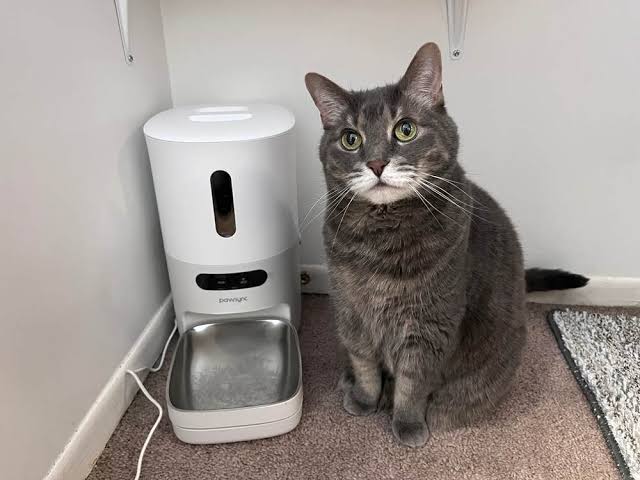
This is the single most important distinction when shopping for an automatic feeder.
Dry Food Feeders
Most automatic feeders on the market are designed for dry kibble. Dry food doesn’t spoil at room temperature, making it easy to store in a hopper for several days.
Works with: Standard kibble, freeze-dried kibble (check size compatibility) Capacity: Usually 3 to 6 liters — enough for 2–4 weeks for a single cat Shelf life in hopper: 5–14 days if sealed properly
Wet Food Feeders
Wet food spoils within 2–4 hours at room temperature. This makes automatic wet food feeding dramatically more complex.
Two solutions exist:
Option 1 — Cooling Feeders: Built-in semiconductor refrigeration keeps wet food cold for up to 3 days. Typically holds 3 meal compartments. Best for cats on all-wet or raw diets.
Option 2 — Rotating Tray Feeders: A circular tray with 5–6 individual compartments covered by a lid rotates to reveal the next meal at the scheduled time. Works for 24–48 hours. Uses an ice pack underneath to extend freshness.
⚠️ Important: Never put wet food in a dry kibble hopper feeder. It will rot inside the mechanism, grow mold, and potentially make your cat seriously ill.
How to Set Up an Automatic Cat Feeder
Setting up a new automatic feeder takes less than 15 minutes. Here’s the general process:
Step 1: Choose the location Place the feeder on a flat, stable surface. Keep it in the same spot your cat currently eats — don’t move the feeding location, just replace the bowl with the feeder.
Step 2: Fill the hopper Add your cat’s regular food. Don’t switch food brands during this transition — your cat has enough to adjust to already.
Step 3: Program the schedule Set meal times and portion sizes based on your vet’s feeding recommendations. Start with your cat’s current feeding schedule — don’t change the timing drastically.
Step 4: Run a test dispense Before leaving your cat alone with the feeder, manually trigger a test meal and watch to make sure the food dispenses correctly and the portion size looks right.
Step 5: Transition gradually For the first few days, be present when the feeder dispenses. Let your cat hear the sound and understand that food comes from this machine. Most cats adapt within 3–5 days.
Step 6: Connect to Wi-Fi (if applicable) Download the companion app, connect the feeder to your home Wi-Fi, and enable push notifications for low food and jamming alerts.
Automatic Cat Feeders for Multiple Cats
Standard feeders don’t work in multi-cat homes with a food bully. One cat will simply push the other away and eat both portions.
The solution: Microchip-activated feeders.
These feeders read your cat’s existing microchip or a special RFID collar tag. The lid only opens when the registered cat approaches — and snaps shut the moment they walk away or another cat gets too close.
Best microchip feeder: SureFeed Microchip Pet Feeder — works with up to 32 individual microchips, has a memory function to track which cat visited and when.
For two cats that don’t steal: Buy two separate feeders — one per cat. Place them in different rooms or opposite sides of the same room. This eliminates competition without the cost of microchip feeders.
Common Problems and How to Solve Them
| Problem | Cause | Solution |
|---|---|---|
| Food not dispensing | Kibble jam in the chute | Clear the jam manually — switch to smaller kibble or a feeder with anti-clog design |
| Cat ignoring the feeder | Unfamiliar noise or appearance | Place feeder next to current bowl first — gradually move bowl away over 5 days |
| Feeder runs out too fast | Cat pushing feeder or pawing | Secure feeder to wall or use a heavier model with anti-tamper base |
| Food going stale quickly | Hopper seal is poor | Switch to a feeder with twist-lock airtight lid and desiccant basket |
| Wi-Fi disconnecting constantly | 5GHz only network | Check — most smart feeders need 2.4GHz specifically, not 5GHz |
| Cat eating too fast | Portion too large or dispensed too fast | Split daily food into 4–6 smaller meals instead of 1–2 large ones |
How Much Does an Automatic Cat Feeder Cost?
| Budget Range | Price | What You Get |
|---|---|---|
| Budget | $20 – $50 | Basic timed dispenser, plastic bowl, limited meal settings |
| Mid-Range | $50 – $100 | Stainless bowl, dual power, accurate portions, better anti-clog |
| Smart / Wi-Fi | $80 – $150 | App control, remote feeding, push notifications, feeding logs |
| Camera Feeder | $120 – $200 | Wi-Fi + live HD camera, two-way audio, night vision |
| Wet Food Cooling | $100 – $200 | Refrigerated wet food dispensing, app control |
| Microchip Feeder | $100 – $180 | Cat-specific access, ideal for multi-cat homes |
💡 Best Value Pick: The $80–$120 Wi-Fi range gives you app control, accurate portioning, dual power, and push notifications — everything most cat owners actually need without overpaying for camera features.
Frequently Asked Questions About Automatic Cat Feeders
❓ Are automatic cat feeders safe?
Yes — when used correctly. Choose a feeder with battery backup so power outages don’t cause missed meals. Clean the bowl and hopper weekly to prevent bacteria buildup. Monitor your cat during the first few days to confirm the feeder is dispensing correctly.
❓ Can I use an automatic feeder for wet cat food?
Yes — but you need a feeder specifically designed for wet food. Standard dry food hoppers will clog, mold, and spoil. Look for a cooling feeder (like the PETLIBRO Polar) or a rotating tray feeder with an ice pack.
❓ How many meals per day should I program?
Most vets recommend 2–3 meals per day for adult cats. Cats prone to vomiting after eating may benefit from 4–6 smaller meals spread throughout the day. Kittens under 6 months need 3–4 meals daily.
❓ What if my cat eats too fast from the automatic feeder?
Split their daily ration into more, smaller meals — 4–6 portions instead of 2. Some feeders also have a slow-feed insert tray that forces cats to eat more slowly. Regular slow-feeder bowls can also be placed under the dispenser.
❓ Will my cat learn to use the automatic feeder on their own?
Most cats adapt within 3–7 days. Be present for the first few feedings so your cat connects the sound of the motor with food appearing. Place the feeder exactly where you currently feed them — don’t change the location.
❓ Can automatic feeders handle large kibble?
Some can, some can’t. Always check the maximum kibble size specification before buying. Most standard feeders work with kibble up to 10–15mm in diameter. Larger pieces or oddly-shaped kibble may jam the dispensing mechanism.
❓ Do I still need to check on my cat if I use an automatic feeder?
Absolutely. An automatic feeder handles meals — but cats also need fresh water (consider a water fountain), social interaction, playtime, and health monitoring. Never leave a cat alone for more than 24–48 hours based solely on the feeder.